
Which Label Type Is Best for Server Rooms?

Lead Specialist, Telecom Digitalization & Identification at MakeID
As Lead Specialist at MakeID, he drives digital transformation for physical asset identification in FTTx. Optimizing field maintenance and data accuracy, he helps global telecoms reduce MTTR and enable real-time asset-data alignment.
In the highly-stakes setting in a data center, one unlabeled patch cord could be that the distinction between quick repair or five hours of unimaginable downtime. There are thousands of similar Cat6A and single mode fiber cables that run across a single rack the implementation of a structured cable labeling system is an essential operational requirement. However, generic consumer tape labels inevitably fail when exposed to the 24/7 heat and static electricity generated by dense blade servers. Selecting the best label type requires a strategic calculation of material science, compliance, and deployment efficiency. Let’s break down the ideal industrial-grade label types to keep your infrastructure permanently organized.
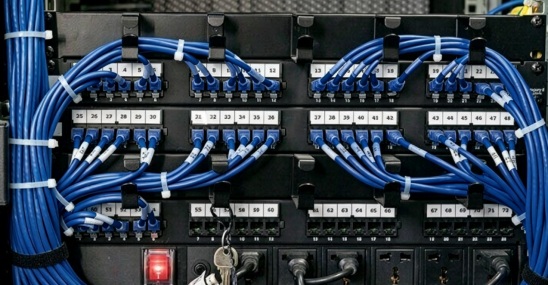
The Operating Standard for Complying with ANSI/TIA-606D
Before evaluating materials, the network infrastructure must be aligned with ANSI/TIA-606 (Telecommunications Standards for Infrastructure Administration). This standard eliminates any uncertainty from structured cabling, by setting specific compliance standards for server rooms and data centers. rooms.
- Both-End Rule: TIA-606D requires that every backbone, horizontal or patch cable has to have a unique identifier at both ends, and within 300 mm (12 inches) of the point where it terminates. This guarantees immediate traceability from either end of the cross-connect.
- Legibility over Handwriting:Handwriting-based tags are a blatant non-compliance. The norm states that all markers should be printed using a mechanical method to avoid fade and misinterpretation in a typical 10-to-15-year commercial service period.
- Adhesion Standards: Labels must resist defacement and maintain permanent adhesion under testing metrics similar to UL969 (Marking and Labeling Systems). In a server room, your labels must survive constant airflow abrasion without peeling.
Deep Dive: Top 4 Cable Label Types Compared
Different vertical runs, cable diameters, and thermal zones require specialized labeling geometry. Here is an architectural breakdown of the four primary industrial label formats.
Self-Laminating Vinyl Wraps: The Heavy-Duty Choice
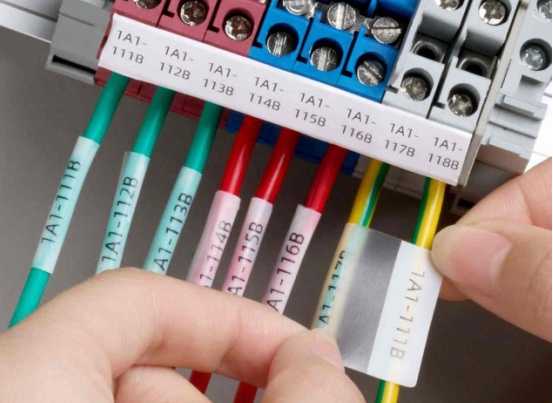
Self-laminating labels comprise an area of white printing, that is followed by a clear tail. When you wrap the labels on the wire translucent vinyl layer wraps around the printed text, securing it within a protective barrier.
Why they excel: The built-in over-lamination provides total immunity to dust, moisture, and scratch damage caused by pulling cables through tight vertical organizers. Because vinyl is naturally flexible, these wraps are the absolute best choice for Cat6/Cat6A patch cords that experience frequent handling and tight bend radii.
Premium PET (Polyester) Tapes: The High-Heat Champion
Polyester (PET) labels provide the most rigid, durable and stable and dimensionally stable surface that is covered with a high-performance adhesive.
Why they excel: Server exhaust zones frequently experience sustained temperatures that dry out standard rubber-based glues. Certified industrial PET label tape remains structurally stable up to 120°C, guaranteeing that labels placed behind high-density core switches will not dry out, curl, or leave a sticky residue upon removal.
Heat-Shrink Tubing: The Permanent Infrastructure Seal
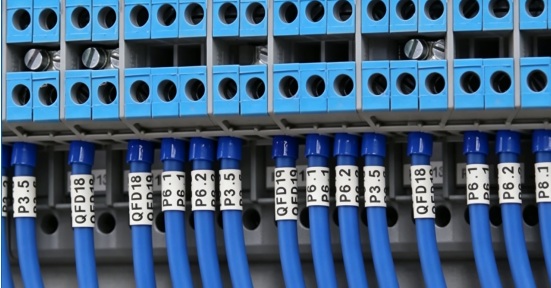
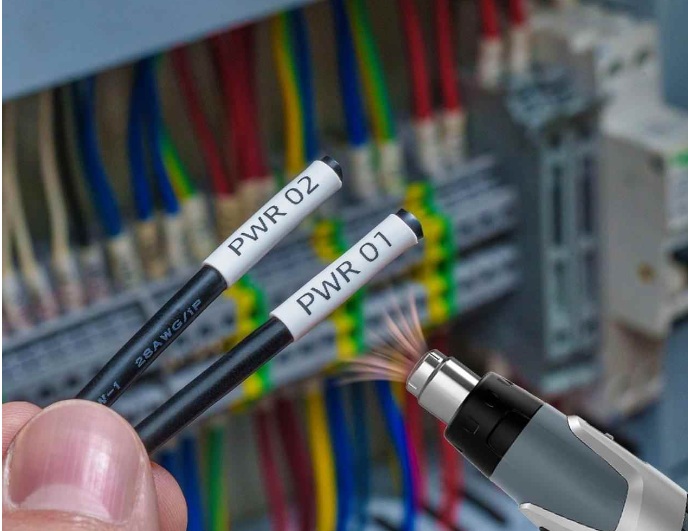
Heat-shrink tubes are adhesive-free, continuous polyolefin sleeves that are printed flat, then slipped over an un-terminated wire and is then shaved down with the heat gun.
Why they are so effective: Since they are based on the 4:1 or 3:1 thermal friction fitting, rather that chemical glues heat shrink tubes offer an unbreakable, non-peeling option. They are the premium choice for bulk infrastructure installation during the rough-in phase, long before connectors or keystones are punched down.
Flag Labels (T-Type/P-Type): Maximizing Data Surface
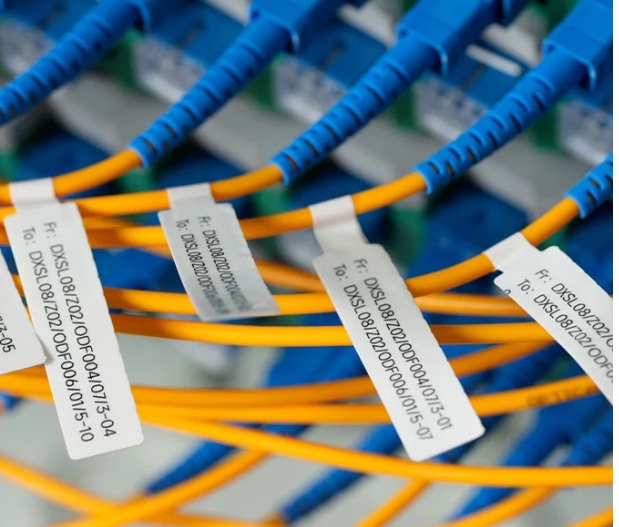
Flag labels extend outward from the cable casing like a small banner, adhering back to themselves around the core wire.
Why they excel: Ultra-thin single-mode and multimode fiber optic jumpers (2.0mm to 3.0mm) do not possess enough surface area for a traditional wrap-around label to remain legible. Flag labels provide a flat, expansive printing canvas perfectly suited for dense alphanumeric strings, system schematics, or high-density QR Codes used for digital asset tracking.
Matching Material Properties to Data Center Assets
When executing an enterprise network deployment, refer to this material compatibility matrix to assign the correct tape composition to your specific hardware layout:
| Label Material / Type | Key Benefit | Maximum Thermal Baseline | Best Data Center Application |
| Self-Laminating Vinyl | Abrasion resistance; smudge-proof overlay | Up to 80°C | Patch panels, cross-connect switches, Cat6 patch cables. |
| Industrial Polyester (PET) | Chemical-resistant; zero adhesive degradation | Up to120°C | Power Distribution Units (PDUs), high-heat exhaust rails. |
| Nylon Heat-Shrink | 100% permanent friction lock; clean finish | Up to 145°C | Bulk backbone runs, un-terminated fiber/copper spools. |
| Polypropylene (PP) Flags | Massive text surface area; zero memory curl | Up to 80°C | Fiber optic jumpers, MPO trunks, barcode asset tagging. |
Scalable Cable Labeling with MakeID
Labeling a massive data room rack-by-rack requires hardware capable of handling high data input without tethering engineers to a desktop workstation. The enterprise ecosystem at MakeID Industrial Label Solutions solves this operational bottleneck.
- Batch Printing via Mobile App: Instead of manually typing individual characters on an awkward integrated keyboard, MakeID’s intelligent mobile interface allows network engineers to import standard Excel or CSV cable schedules directly over a local Bluetooth mesh. This completely eliminates transcription errors and automates alphanumeric serialization on the fly.
- Precision 300 DPI Thermal Transfer: In high-density patch environments, patch panel labels must be incredibly compact yet razor-sharp. MakeID’s advanced thermal printing mechanisms output ultra-crisp text and micro-barcodes on continuous media widths, ensuring flawless clarity even at miniature text scaling.
- Industrial-Grade Adhesives: Engineered to withstand the relentless vacuum pull and static currents generated by server cooling walls, MakeID’s cable-specific tapes utilize high-tack resins that resist sliding or flagging, keeping your installation compliant for years to come.