
What Should You Know About Data Center Cabling

Lead Specialist, Telecom Digitalization & Identification at MakeID
As Lead Specialist at MakeID, he drives digital transformation for physical asset identification in FTTx. Optimizing field maintenance and data accuracy, he helps global telecoms reduce MTTR and enable real-time asset-data alignment.
Modern businesses are powered by data and data centers are the foundation that keep clouds computing AI streams, workloads and enterprise systems running throughout the day. But behind every fast and reliable network lies the foundation that is often overlooked of Data center cables. Poor cabling design can cause downtime, overheating, signal interference and expensive maintenance issues; on the other hand, carefully planned cabling infrastructure improves network performance while simultaneously increasing scalability and operational efficiency – whether building new facilities or upgrading existing facilities; understanding best practices regarding cabling is essential to long-term reliability and future growth.
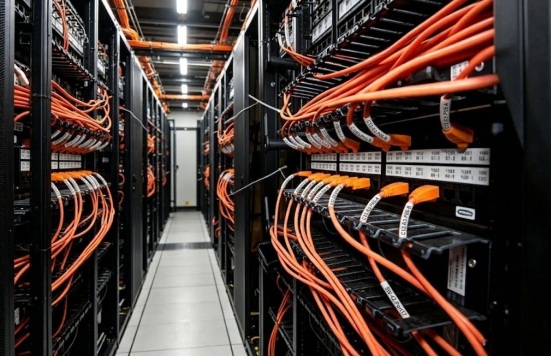
Types of Data Center Cabling
The selection of the appropriate cabling solution is one of the most crucial decisions made when it comes to planning the infrastructure of a data center. Different types of cables offer distinct advantages based on distance, speed as well as scalability and budget.
Copper Cabling
Copper Cabling remains popularly utilized within enterprise data centers due to its affordability and easy installation process. Common categories for copper cabling in these facilities are Cat5e, Cat6, -Cat6A and Cat8 cables with Cat6A being most favored for deployment of 10GB Ethernet applications.
- Cat8 cables offer higher bandwidth capabilities and have become an essential element of high performance environments.
Copper cables are ideal for transmission distances that are shorter as well as smaller deployments. However they are more prone for electromagnetic interference (EMI) and also have limits on distances compared to fiber optics.
Fiber Optic Cabling
As AI cloud computing, AI and data center hyperscale continue to expand fiber optic cables have been the most popular option for high-speed networking.
Fiber has many advantages.
- Higher capacity for bandwidth
- Speeds of transmissions that are faster
- Lower latency
- Longer transmission distances
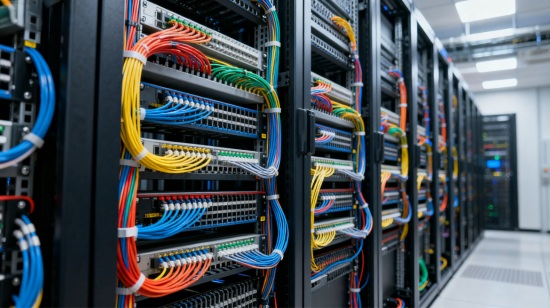
Better resistance to EMI
There are two primary kinds of fibers:
- SMF: Single mode fiber (SMF): Designed to be used for communication over long distances
- Multi-Mode Fiber (MMF): MMF cables are commonly utilized within data centers for short distance communications needs.
The International Data Corporation (IDC) conducted industry research which found that worldwide data creation exceed 175 zettabytes per year, drastically increasing the demand for high-speed fiber infrastructure.
Structured Cabling vs Point-to-Point Cabling
Structured cabling employs a standard design that organizes cables into easily manageable systems. This method makes maintenance simpler and troubleshooting as well as future expansion.
Point-to-point cabling connects devices, but it can become unorganized in large-scale environments.
Modern data centers use structured cabling due to its benefits:
- Better scalability
- Easier cable management
- Reduced downtime
- Improved efficiency of airflow
Key Standards for Data Center Cabling
Industry standards provide security, reliability, and compatibility across different data center environments.
TIA-942 Standard
The TIA-942 standard is among of the most well-known frameworks for designing the infrastructure of data centers. It offers guidelines for:
Systems for cabling
- Redundancy
- Cooling
- Network reliability
- Physical security
This standard defines tiers for data centers that range from Tier I up to Tier IV determined by standards for fault tolerance and uptime.
ANSI/TIA and ISO/IEC Standards
International standards organizations like ANSI/TIA and ISO/IEC set the best practices for structured cabling and the telecommunications infrastructure.
These standards help companies:
- Improve interoperability
- Reduce installation errors
- Simplify future updates
- Maintain long-term performance
Color Coding and Cable Identification
Color codes are essential to identify quickly different types of network functions, types or departments within complex data center settings.
Together with professional cable labeling system, color-coded cables can dramatically reduce the time needed to troubleshoot and also minimize errors made by humans during maintenance.
Common Challenges in Data Center Cabling
Advanced facilities experience severe operational problems because their cable systems remain in poor management.
Cable Congestion
High-density server racks contain thousands of cables which occupy restricted space. Cable congestion without proper organization creates three problems because it:
- Restricts airflow
- Increases heat buildup
- Reduces cooling efficiency
- Complicates maintenance work
Overheating represents the primary cause of hardware malfunction in data centers.
Poor Cable Labeling
One of the most common yet costly mistakes is inadequate cable labeling.
Unclear or missing labels make it difficult for technicians to identify connections quickly. The system experiences outages and upgrades because it creates:
- Longer troubleshooting times
- Accidental disconnections
- Increased downtime
- Higher labor costs
Business operations lose thousands of dollars from every minute their mission-critical systems experience downtime.
Scalability Limitations
Organizations experience increasing bandwidth demands which their existing cabling infrastructure cannot handle. The absence of scalable infrastructure planning results in expensive and disruptive upgrade processes.
Downtime Risks
A single incorrectly disconnected cable can impact servers, storage systems, and entire network segments. Business operations depend on reliable cable management because it directly supports business continuity.
Best Practices for Data Center Cabling
Implementing best practices will greatly enhance efficiency of operations and cut the long-term costs of maintenance.
Use Structured Cabling Design
Structured cabling provides a more efficient, clean infrastructure that will allow for the future growth.
Benefits include:
- Easier troubleshooting
- Faster deployment
- Simple maintenance
- Better airflow management
Modular design also allows companies to expand their infrastructure without significant disruptions.
Implement Proper Cable Labeling
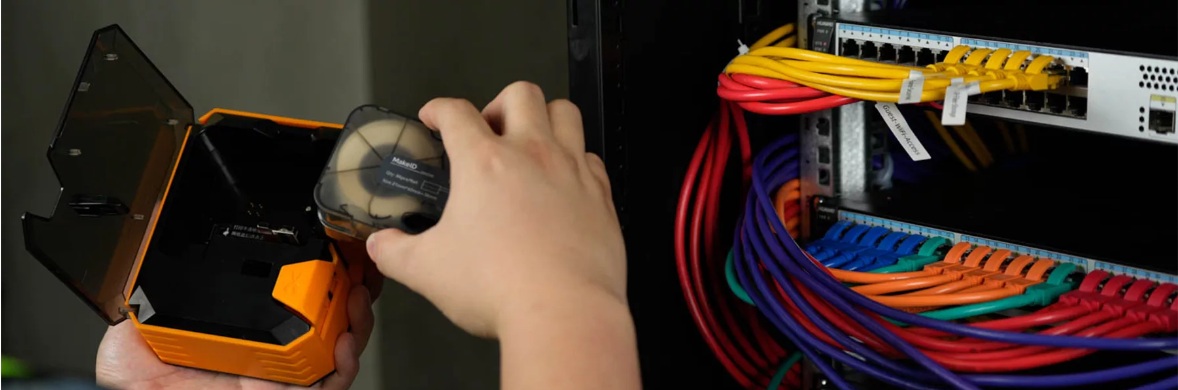
Every cable should be equipped with an easy-to-read, durable label that clearly states the purpose of the cable and its destination.
Solutions for industrial labeling are vital in data centers as cable cables can be exposed to
- Heat
- Friction
- Frequent handling
- Long-term wear
Professionally designed labeling systems aid technicians to find connections quicker and decrease the chance of making mistakes in operation.
Many IT departments now utilize industrial-grade label printers as well as self-laminating cable labeling to increase quality and readability in high-density environments.
Separate Power and Data Cables
Separating power cables from data cables reduces electromagnetic interference, and also improves the integrity of signals.
Trays for cables and routing paths that are dedicated to specific routes are often used to ensure an appropriate separation.
Maintain Airflow Efficiency
A good airflow is essential to cool modern servers and networking equipment.
The best practices are:
- Using horizontal and vertical cable managers
- Avoiding too much cable bundling
- Keeping pathways clear
- Organizing cables based on function
A well-managed cable is a key element to efficient cooling systems that are energy efficient.
Plan for Future Expansion
The demand for bandwidth continues to grow quickly due to AI applications Edge computing, edge computing, as well cloud computing services.
The cabling system should be designed by organizations with the future in mind by:
Reserve rack space for an additional rack
- Installing fibers with greater capacity
- Utilizing flexible structured cabling systems
The ability to plan ahead for infrastructure improvements can reduce the cost of future upgrades.
Choose the Right Data Center Cabling Solution
The correct cabling solution needs to be selected based on three factors which include operational goals and budget needs and requirements for scalable systems.
Consider Bandwidth Requirements
Current workloads which include AI processing and virtualization and big data analytics need advanced networking systems with high-speed capabilities.
Fiber optics are the most common option chosen by organizations which need to implement 40G and 100G and upcoming 400G network systems.
Evaluate Distance and Speed
Copper wire provides an affordable solution for brief distances while fiber optic cables deliver superior performance across extended distances.
Organizations should balance cost and speed and future scalability when selecting cabling types.
Think About Long-Term Maintenance
Maintenance needs to be simple to perform because it holds equal importance with the cost of initial installation.
Technicians experience reduced workload when cabling systems receive proper organization which also decreases system downtime and makes upcoming upgrades easier to execute.
Choose Reliable Labeling Tools
Professional cable identification tools help organizations become more efficient while making their infrastructure assets easier to track.
Industrial labeling systems from MakeID help data center teams create durable cable labels designed for complex networking environments.
Professional cable identification tools improve operational efficiency and infrastructure visibility.