
Thermal vs Thermal Transfer Print Head: Key Differences

Lead Specialist, Telecom Digitalization & Identification at MakeID
As Lead Specialist at MakeID, he drives digital transformation for physical asset identification in FTTx. Optimizing field maintenance and data accuracy, he helps global telecoms reduce MTTR and enable real-time asset-data alignment.
Have you ever encountered such a situation: the label printer has been in use for two or three years, but suddenly it starts to print unclearly, with thin white lines appearing, or even entire lines being blank. The first reaction is to change the paper and the carbon tape, and after a round of troubleshooting, the problem still persists. At this point, the real cause is often overlooked – the print head.
The print head is the most crucial and also the most likely component to be regarded as a black box in a label printer. Unlike the carbon tape, its usage can’t be easily identified at a glance, nor does it have obvious physical indicators like the label paper. However, in fact, the condition of the print head directly determines the output quality of each label.
What Is Print Head? The Role Does It Play In Label Printers
Print Head, also known as Thermal Print Head (TPH), is essentially a ceramic strip with a dense array of miniature heating elements. These heating elements are arranged in a grid pattern, with each “point” corresponding to a pixel on the final label.
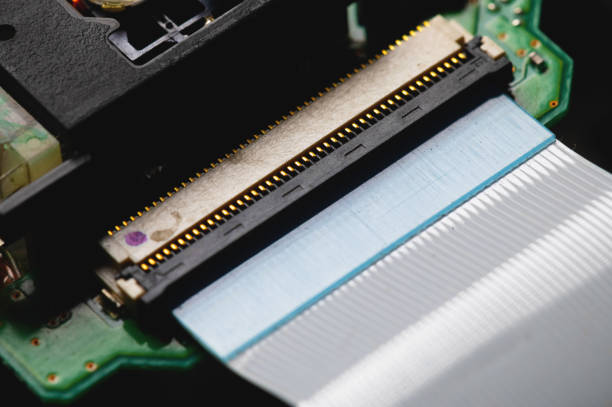
In the physical structure of a label printer, the print head is located directly above the platen roller, and the gap between them is extremely small. The label paper (thermal type) or “label paper + carbon tape” (thermal transfer type) passes through this gap, and the print head forms an image line by line on the paper by precisely controlling the activation timing of each heating element.
Tip: How is the print head lifespan measured?
The print head lifespan is usually indicated in “Printed Inches” or kilometers of printing, rather than in years. Consumer-grade print heads typically range from 200,000 to 500,000 inches, while industrial-grade can exceed 1 million inches. Converted to an A6-sized delivery label (approximately 4 inches long), 1 million inches is equivalent to approximately 250,000 prints.
Thermal Printhead: Uses “Heat” To Image Directly On Paper
The imaging of the thermal printing head relies on the special coating structure of the thermal paper itself.
The surface of the thermal paper is coated with a thermal sensitive layer, which contains two key components: a color developer and a leuco dye. These two substances are isolated from each other at room temperature, and the paper appears white. Once a local temperature exceeds the threshold (usually above 60°C to 80°C), they undergo a chemical reaction, and the area becomes black, forming a visible image.The numerous heating elements on the printing head are precisely the “switches” that trigger this reaction. Each heating element is extremely small and can be heated and cooled within a few milliseconds through precise current pulse control.
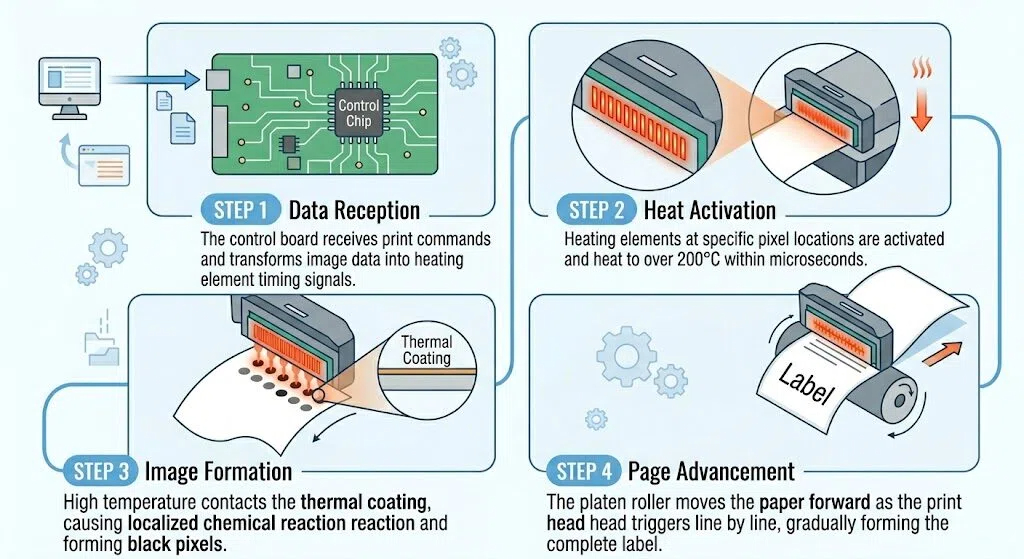
The Imaging Process Is Broken Down Into Steps
Step 1: Data Reception – The control board receives the printing instructions and converts the image data into a timing signal for the heating elements.
Step 2: Heating Trigger – The heating elements at the corresponding pixel positions heat up to above 200°C within microseconds.
Step 3: Chemical Coloring – The high temperature comes into contact with the heat-sensitive coating, causing a local coloring reaction, forming black pixel points.Step 4: Line-by-Line Progression – The paper press roller drives the paper forward, and the printing head triggers line by line, gradually forming the complete label.
Advantages and Limitations of Thermal Heads
- Advantages: Simple structure, no carbon tape or ink, low consumable cost, and easy maintenance.
- Limitations: Thermal images will fade when exposed to heat, light, or oil. They are not suitable for long-term preservation; can only use thermal paper and cannot print on synthetic materials such as PET and PP; only suitable for short-term label scenarios like courier labels and supermarket receipts.
Thermal Transfer Printhead: Indirect Imaging Using a Carbon Ribbon As “Intermediate Medium”
The imaging logic of thermal transfer printing heads is completely different from that of thermal sensors: it does not rely on the chemical reactions of the paper itself, but instead heats the ink layer on the carbon tape, melts the ink, and then transfers it to the substrate of the label through heating.
Ribbon is the core consumable of thermal transfer printing, consisting of three layers:
- Back Coating: Facing the printing head, it contains lubricating substances to protect the printing head from direct friction with the base film.
- Base Film: A polyester (PET) film, which serves to support and conduct heat.
- Ink Layer: Facing the label, it contains wax, resin, or a mixture of both, and is a heat-meltable ink.
The heating element of the printing head penetrates the base film and conducts the heat to the ink layer, causing a local melting of the ink layer. Under the pressure, the melted ink adheres to the surface of the label substrate, and the base film of the carbon tape then separates from the ink – this is the “transfer”.
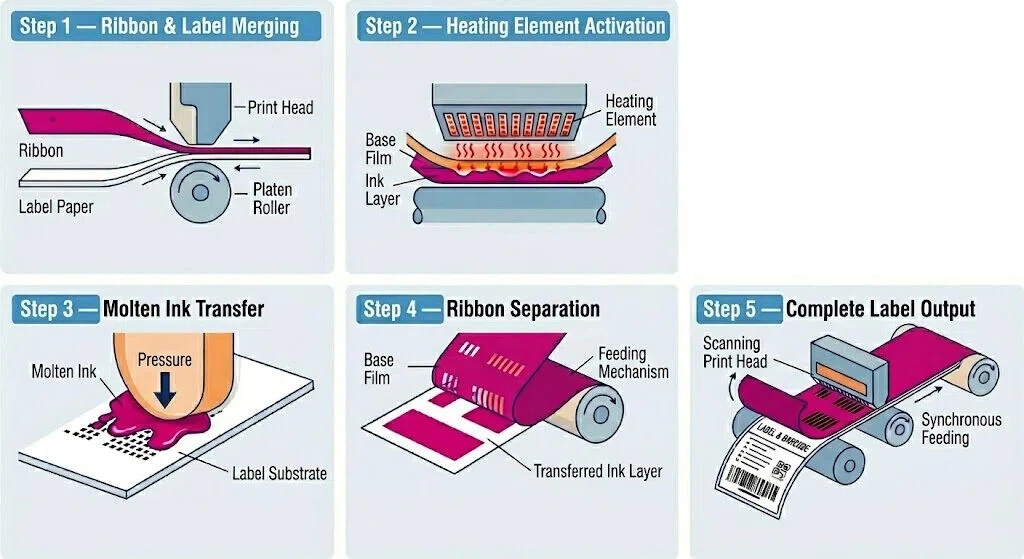
The Imaging Process Is Broken Down Into Steps
Step 1 – The carbon tape and label paper are overlapped (with the ink layer facing the label), and they pass through the gap between the print head and the paper press roller together.
Step 2 – The heating element is triggered, and heat passes through the carbon tape base membrane, causing the ink layer to partially melt.
Step 3 – The melted ink migrates under pressure from the carbon tape to the surface of the label substrate, forming pixel points.
Step 4 – The carbon tape base membrane is separated from the label paper by the paper movement mechanism, leaving the transferred ink layer behind.
Step 5 – The print head scans line by line, and the carbon tape and the label move synchronously, resulting in the complete output of the label.
Advantages and Limitations of Thermal Transfer Heads
- Advantages: Strong image durability, capable of withstanding high temperatures, UV radiation, oil stains and chemicals; Wide adaptability of substrates, capable of printing on various materials such as PET, PP, and coated paper; Suitable for high durability scenarios in industries like manufacturing, healthcare, and logistics.
- Limitations: Requires carbon tape consumables, with higher ongoing costs; Incompatibility between carbon tape type and substrate will accelerate the wear of the print head; Maintenance requirements are higher than those of thermal printers.
Core Differences Between Thermal Heads and Thermal Transfer Heads
| Comparison dimensions | Thermal printing head | Thermal transfer printhead |
| Imaging medium | Thermal paper coating (chemical reaction) | Carbon tape ink layer (heat fusion transfer) |
| Whether carbon tape is required | No need | Must be used with carbon tape |
| Image durability | Weak (easy to fade, avoid heat and light) | Strong (weather-resistant, chemical-resistant) |
| Applicable substrate | Special for heat-sensitive paper | Copperplate paper, PET, PP, etc. |
| Applicable scenarios | Express labels, supermarket receipts | Industrial labels, medical labels, asset labels |
| Source of print head wear | Direct friction on the paper surface Low | Carbon tape back coating + double friction on paper surface |
| Maintenance complexity | Low | Medium to high |
| Word material cost | Low | High (paper + carbon tape) |
How do Ribbons Affect the Wear of Thermal Transfer Printheads?
Lubrication mechanism of carbon belt back coating
Many people know that the function of carbon tape is to “transfer ink”, but they overlook the other aspect – the protective function of the back coating.
The back coating on the carbon tape contains solid lubricants (usually silicone-based compounds), which form a thin lubricating film between the ceramic heating surface of the print head and the carbon tape. This significantly reduces the friction coefficient between the two.
When the back coating fails or is of poor quality, the ceramic surface of the print head directly contacts the PET base membrane of the carbon tape. In a high-temperature and high-pressure environment, this is equivalent to rubbing a precision optical component with sandpaper – continuous printing for several hundred hours may be equivalent to the wear and tear of normal use for several thousand hours.
The degree of wear of three types of carbon tape to the printing head
| Carbon ribbon type | Ink layer composition | Printhead Wear | Applicable substrates |
| Wax | Wax | Low | Copperplate paper, ordinary paper |
| Wax-Resin | Wax + Resin | Medium | Synthetic paper, semi-glossy material |
| Resin | Pure Resin | High | PET, PP, synthetic materials |
The resin carbon tape has strong resistance to solvents and friction, but it also causes the most severe wear to the print head. When using resin carbon tape, a print head specially designed for high wear resistance should be selected, and the cleaning frequency should be appropriately increased.
Matching principle between carbon bandwidth amplitude and print head
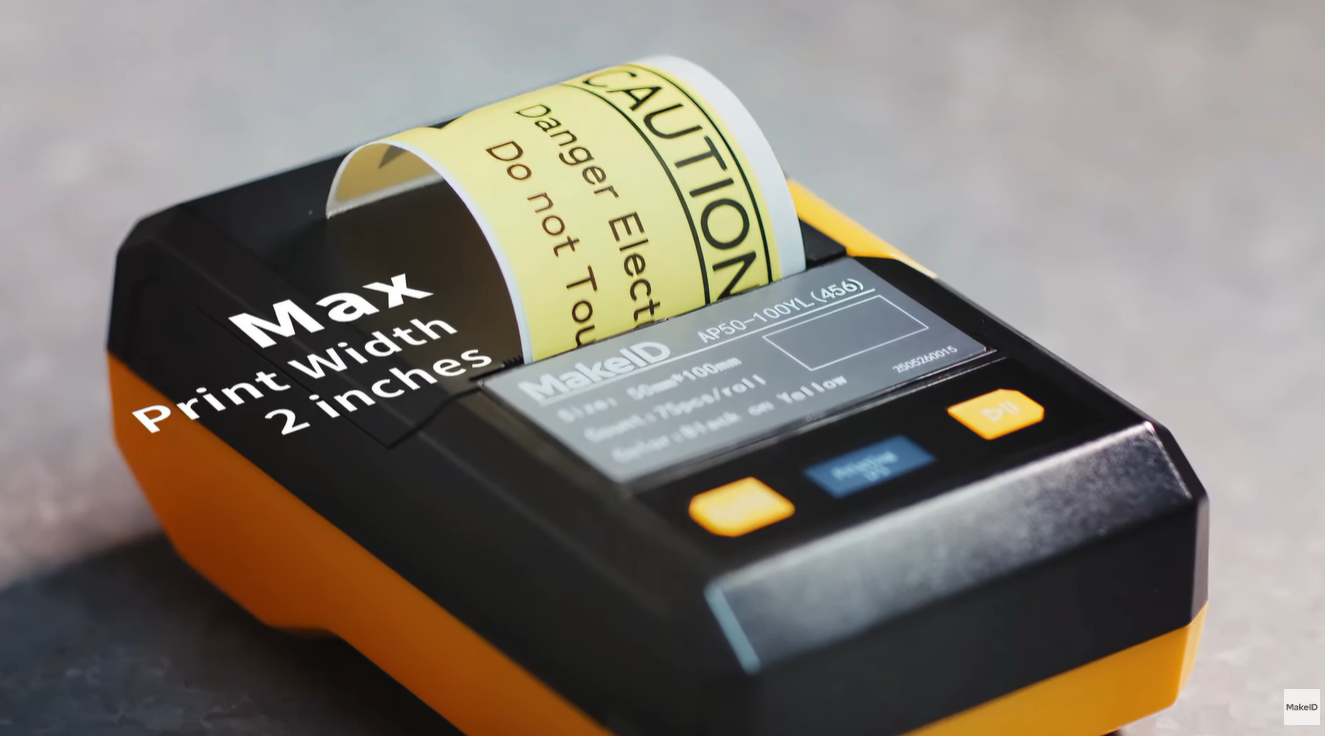
The width of the carbon tape should be slightly wider than the width of the label. It is recommended to be 2 to 4mm wider to ensure that the surface of the print head is always completely covered by the carbon tape. If the width of the carbon tape is less than that of the label, the edges of the print head will rub directly against the substrate of the label, and this area will be the first to suffer damage, showing persistent white stripes at the edge.
Selection Recommendation
| Your usage scenarios | Recommended technology | Purchase Highlights |
| Express delivery labels, takeout receipts | Thermal printing | Printing speed, compatibility with thermal paper |
| Warehousing logistics, product barcodes | Heat transfer (wax base/mixed base) | Speed, compatibility with carbon tape, lifespan |
| Medical labels, test samples | Heat transfer (mixed base/resin base) | Accuracy, durability certification |
| Outdoor assets, cable labels | Heat transfer (resin base) | Label weather resistance, carbon tape durability grade |
| Fine packaging, jewelry tags | Color heat transfer | Printing color gamut, substrate glossiness |
Frequently Asked Questions
Q1: How often should the print head be replaced?
It depends on the printing volume and maintenance conditions. For consumer-grade models, it is approximately 1 to 3 years; for industrial-grade models, with proper maintenance, it can last 3 to 5 years. The basis for judgment is the printing quality, not a fixed time limit.
Q2: Can a thermal printer be switched to thermal transfer mode?
No. There are fundamental differences in the mechanical structure of the two. Thermal transfer printers have dedicated carbon tape feeding and returning mechanisms, which cannot be achieved through software switching or simple modifications.
Q3: What causes the white lines in the print head?
There are two types of white lines: dirt blockage (which can be eliminated after cleaning) and heating element failure (cleaning is ineffective and the position is fixed). The distinction method is described in Section 8.
Q4: Will reversing the carbon tape cause damage to the print head?
It will result in blank printing. Usually, it won’t be immediately damaged, but if forced printing is done, the print head will directly contact the smooth base film, causing more wear than normal use. If you find the reaction, stop the machine immediately.
Q5: Can the print head be repaired by itself after damage?
It is almost impossible. The heating element is a micron-level precision manufacturing unit, and the failure of the element cannot be repaired by the user. The damaged print head should be replaced with the original or compatible brand replacement print head.