
RFID VS Barcode: Which Asset Tracking Is Right for Your Business?
In the field of telecom, asset management goes beyond than “counting boxes”–it can be the basis of financial and network health. Everything from base station components to fiber components, to data center components and spare parts telecom assets are important as they are widely distributed and continuously changing.
As networks grow and the infrastructure gets more complicated companies are often faced with the same issue: should you rely on barcodes, or should you change with RFID?However, this question often falls short of the point. The most important thing to consider isn’t which one is “better” in theory, but which label is more in line with your current business model.
Understanding the Basics of RFID and Barcode Labels
What Is RFID Asset Tracking?
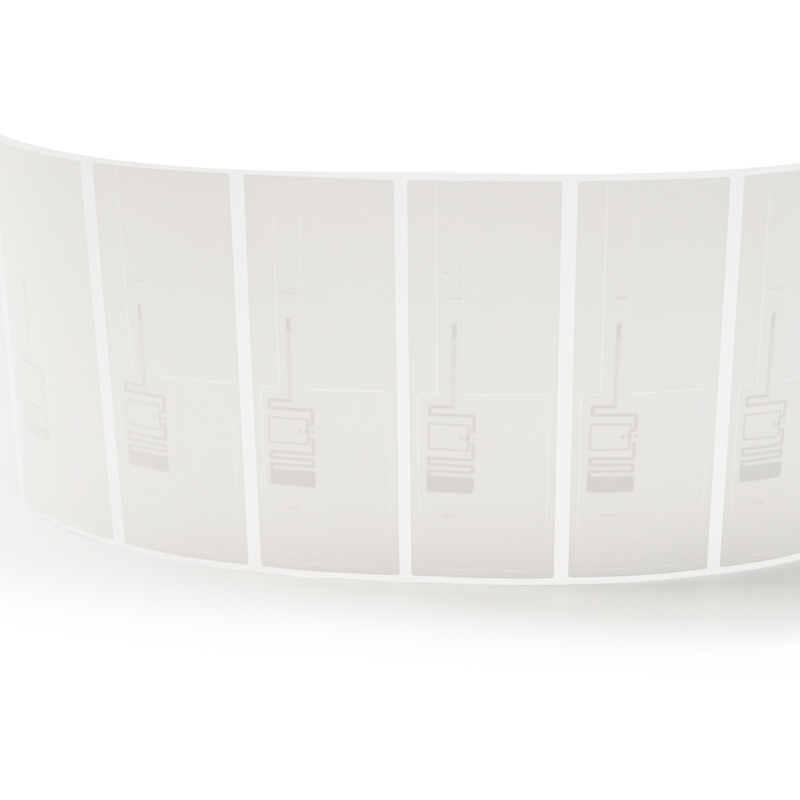
RFID, or Radio Frequency Identification makes use of radio waves to detect and track the tagged items instantly. Every RFID tag has an antenna and chip that communicates with the reader, allowing information to be retrieved in a non-physical way without direct physical line of sight or contact.
In telecom settings, RFID is often used to identify high-value equipment and automate inventory counts and to monitor assets in areas where manual scanning is costly or impossible. Based on the type of tag, RFID can support real-time or near-real-time visibility.
What Are Barcode Labels?
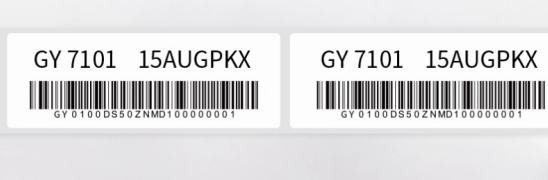
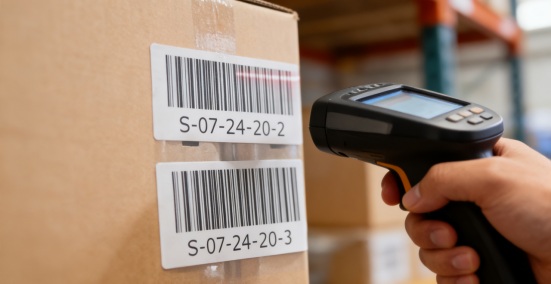
Barcode labels are used to store information about assets in a coded image that can be read using an handheld device or a portable scanner. This method has been extensively used for decades because of its ease of use and the low barrier to entry.
Barcodes in telecom operations are typically employed for tools, spare parts and fixed-location assets. They are simple to deploy and are effective when assets are handled in a separate manner and monitored through workflows that are defined.
RFID vs Barcode Labels: Key Differences at a Glance
| Comparison Dimension | Barcode Labels | RFID Labels |
| Reading Method | Single scan Manual operation | Large-scale reading (up to 100 tags/sec) and automated |
| Reading Distance | Short (0.1-0.5 meters) | Long (0.5-10 meters, based on the kind) |
| Line-of-Sight Required | Absolutely, scanning is essential for success | No, but it can be a way to overcome obstacles. |
| Data Capacity | Low (only the basic asset ID) | High (stores maintenance records, locations and more) |
| Environmental Adaptability | Lack of resistance to humidity, dust and metal interference | Resistant to moisture, dust and metal (with metal-resistant tags) |
| Cost Structure | Low | High |
Asset Tracking Challenges Unique to the Telecom Industry
Before deciding on a solution take into consideration the particular challenges of the telecom industry:
- High-Density Metal Environments: Data centers are stuffed with racks made of metal, which could reflect or block the RF signals.
- Outdoor Extremes: The equipment mounted on towers has to be able to handle extreme UV exposure, rain as well as extreme temperature.
- Highly mobile: The asset are moved frequently between the warehouse, the truck of the technician and the field location.
- Electromagnetic Interference: The high-frequency signals of transmitters interfere with equipment for tracking.
The right tracking technique means taking into account these operational facts.
When RFID Is the Better Choice for Telecom Asset Tracking
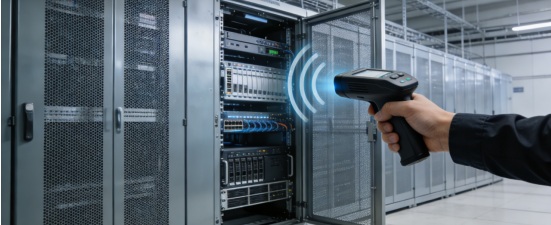
RFID is especially well-suited to telecom companies that handle large amounts of assets, or those that require automation. In data centers and central offices, RFID enables rapid inventory check-ups without shutting down the operation and opening racks.
Equipment for base stations as well as high-value parts, RFID reduces the risk of theft by providing quicker identification and tracking of location. Also, it reduces manual labor which is crucial for telecom companies that operate across several areas.
RFID is usually preferable when assets move regularly where speed and accuracy are crucial, or when real-time visibility is a requirement for maintenance or compliance requirements.
When Barcode Labels Make More Sense
Barcodes are a good choice for budget-conscious companies or for small-scale asset management. They are ideal when assets have fixed locations and low turnover since manual scanning is manageable. Barcodes can also be used for quick, simple installation, with no technology or integration into systems is required. They are ideal for low-value assets or those with short lives like maintenance tools, inventory of spare parts as well as temporary projects-based assets. This means that you don’t have to invest in complicated technologies for the most basic needs of tracking.
How to Choose the Right Asset Tracking Solution
Selecting between barcode and RFID labels is contingent on how your company’s telecom operations are today and the way it intends to expand. Think about the amount of assets you have to manage and how frequently they are moved and the settings that they operate in.
If speed, scalability and automation are the top priorities, RFID may provide long-term operational advantages. If efficiency and control of procedures are the most important factors, then barcode tracking might be enough. In many instances telecom companies, they opt for a hybrid approach employing RFID to identify critical assets, and barcodes for other items.
Making the Right Choice for Long-Term Efficiency
There’s no universal answer in comparing RFID and barcode labels for tracking telecom assets. The best solution is dependent on the complexity of your operation and asset value as well as the requirements for visibility. If you know the performance of each technology in real-time telecom scenarios and scenarios, you can make an informed choice which improves efficiency and lowers risk.
The most effective asset tracking system can support your network today, but is adaptable enough to meet the demands of tomorrow.
If you’re in search of an accurate label printer that can produce RFID and Barcode, MakeID M400A is worth considering as a viable option to label telecom assets and identification.