
Passive vs Active RFID Labels: Key Differences

Lead Specialist, Telecom Digitalization & Identification at MakeID
As Lead Specialist at MakeID, he drives digital transformation for physical asset identification in FTTx. Optimizing field maintenance and data accuracy, he helps global telecoms reduce MTTR and enable real-time asset-data alignment.
RFID (Radio Frequency Identification) is a technology that automatically transmits data between labels and readers using radio waves. Unlike traditional barcode labels, RFID does not require visual alignment and can scan dozens or even hundreds of labels simultaneously in batches, and can still function reliably even in obstructed or harsh environments.
People often confuse RFID with NFC (Near Field Communication). NFC is essentially a subset of HF RFID, with a very short reading distance (≤ 10 cm), mainly used for payment and mobile phone pairing; while the complete RFID ecosystem covers reading distances from a few centimeters to over 100 meters, with much broader application scenarios.Whether RFID labels have their own batteries can be divided into Passive and Active types. This article will introduce to you the differences in technology and application scenarios between the two different types of RFID labels.

Control How RFID Works
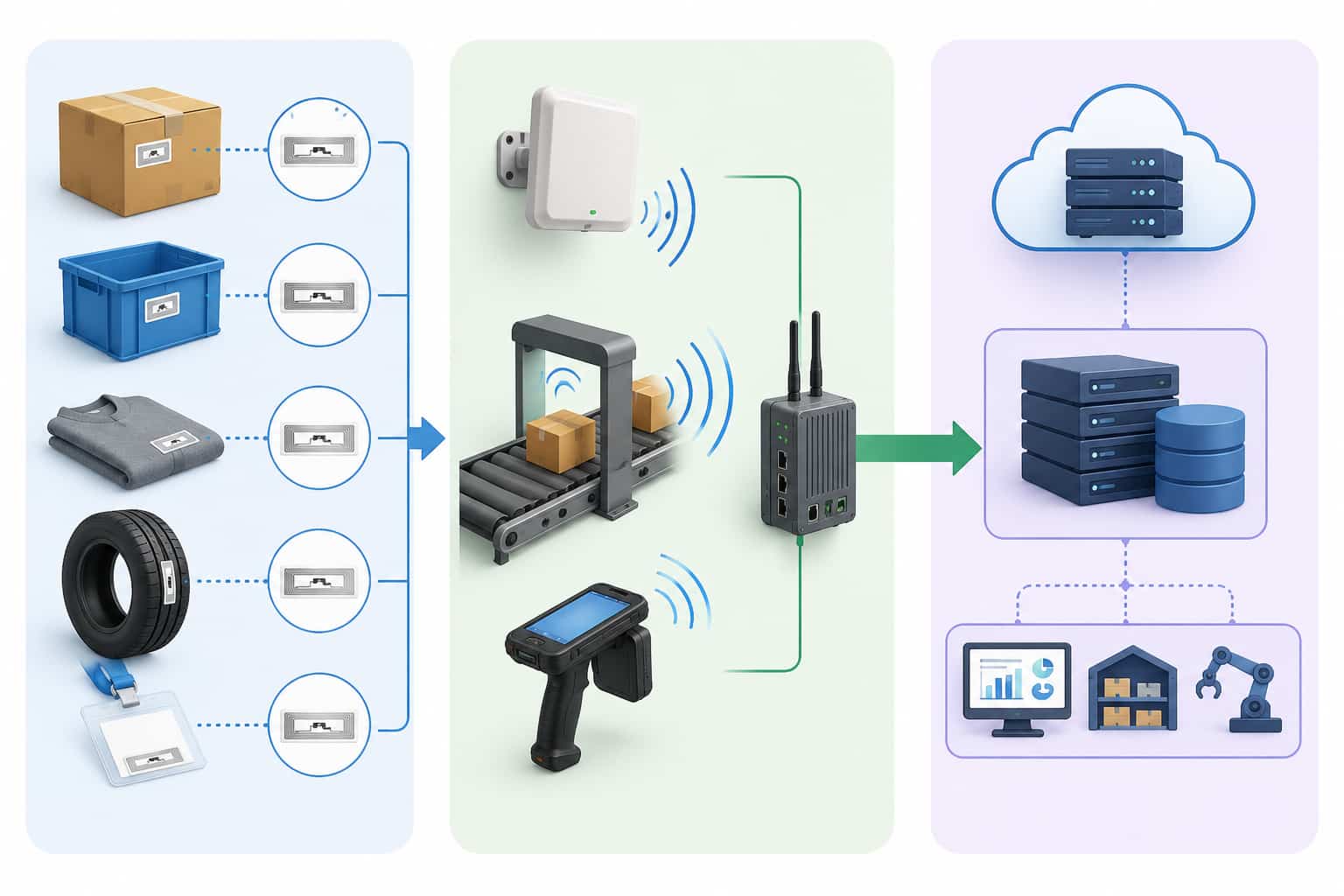
A complete RFID system consists of three layers:
labels: Attached to the objects to be tracked, they store unique identifiers (EPC) and optional user data. labels are composed of antennas and chips, and some types also incorporate batteries or sensors.
Readers/Interrogators: Emit radio frequency signals, receive label responses, and upload data to the backend system. They can be fixed door type, conveyor belt embedded type, or handheld mobile type.
Backend system: Middleware, database or cloud platform, responsible for data filtering, event processing and business integration (ERP / WMS / IoT platform).
Operating frequency band
| Frequency band | Typical frequency | Reading distance | Main applications |
| LF (Low Frequency) | 125 / 134 kHz | < 50 cm | Animal ear labels, access control, mobile NFC |
| HF (High Frequency) | 13.56 MHz | < 1 m | Libraries, ticketing, NFC |
| UHF (Ultra High Frequency) | 860–960 MHz | 1–12 m | Retail, supply chain, warehousing |
| Microwave (Microwave) | 2.4 / 5.8 GHz | 30–100+ m | Vehicle tracking, Active RTLS |
The core principle of energy transmission is electromagnetic coupling: The reader antenna radiates a radio frequency field outward, and the label antenna acquires energy from it (passive) or responds actively by using its own battery (active).
Analysis of Passive RFID
Passive RFID labels do not contain batteries. When they enter the radio frequency field range of the reader, the label antenna senses electromagnetic energy and supplies power to the chip. Then, through the backscatter method, the data is modulated on the reflected wave and returned to the reader. The entire process is completed within milliseconds, and the label itself does not perform any active actions.
The direct benefit brought by this design is that the labels theoretically have an infinite lifespan and require no maintenance.
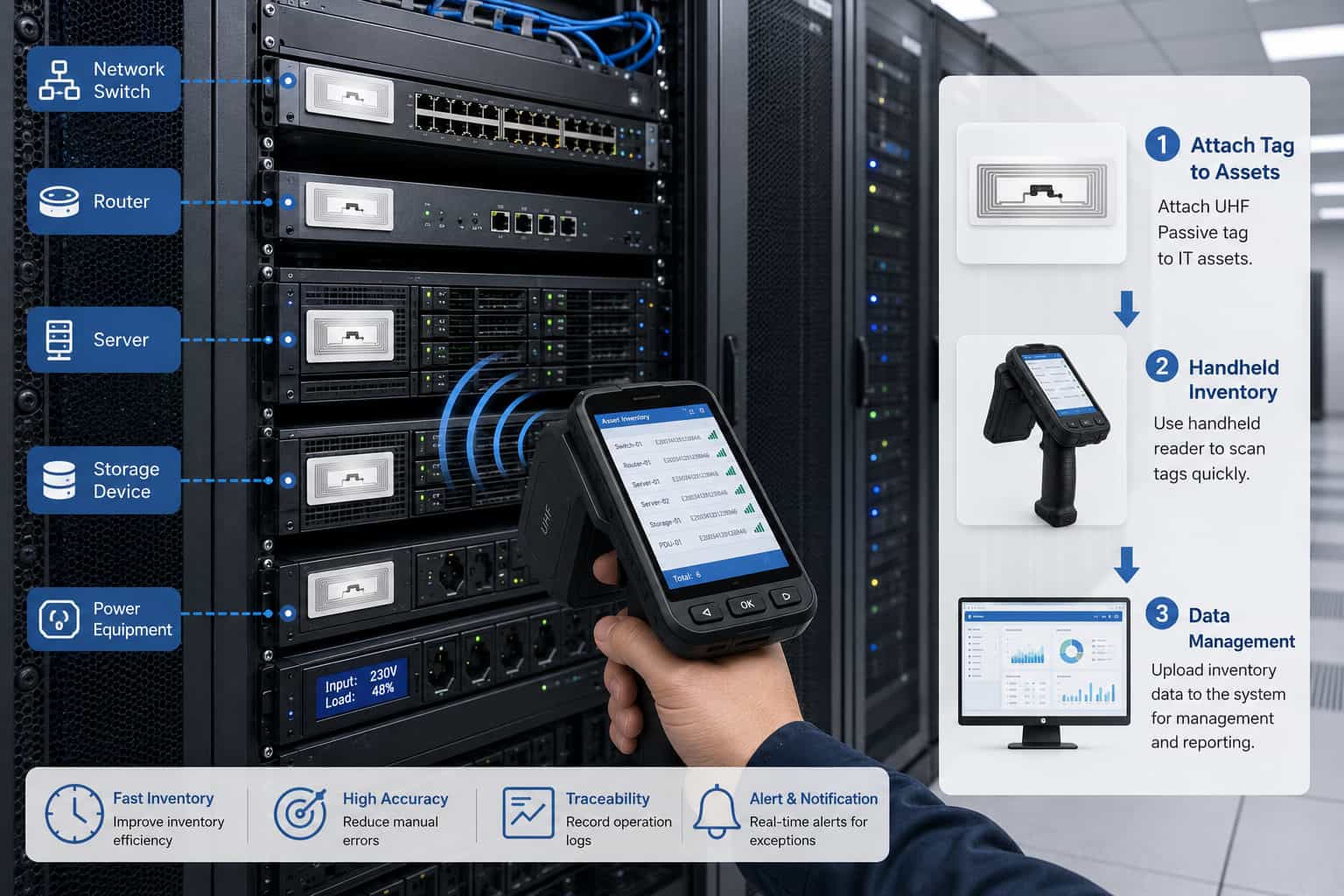
Advantages
- Low cost: With large-scale purchasing, the unit price of UHF wet Inlay can be as low as $0.05 – $0.15
- Ultra-thin in size: Can be printed on ordinary label paper and coexist with existing barcode labels
- Maintenance-free: No batteries, no moving parts, exists throughout the entire lifecycle of the items
- Large-scale deployment: Retailers can deploy it simultaneously on billions of items, with controllable costs
Limitation
- Near-field activation with reader is required: Under ideal UHF conditions, the effective distance is approximately 10–12 meters. However, in actual warehouses, metal shelves and dense stacking will compress this effective distance to 1–3 meters.
- Interference from metals and liquids: Special On-Metal labels (with foam isolation layers) need to be used, which are more costly.
- No real-time positioning capability: Only “the label passed a certain reader” can be known. Continuous tracking of position is impossible.
- No sensors (standard type): Ordinary Passive labels cannot collect environmental data such as temperature and humidity.
Analysis of Active RFID
Active RFID labels have built-in batteries and actively broadcast signals, without waiting for the reader to activate them. The reader essentially becomes a “listener”, continuously receiving data frames sent by the labels. This fundamental reversal has increased the reading distance from the ~10 m of UHF Passive to 30–100+ m.
Two sub-types
Transponder (Response): Usually in a dormant state, it only activates and responds after receiving a wake-up signal from the reader. It is energy-efficient, with battery life up to 5–7 years, suitable for asset tracking that does not require continuous broadcasting.
Beacon (Beacon): Actively broadcasts signals at fixed intervals (such as every 1 second or every 30 seconds). It is highly real-time and can be combined with RTLS (Real-Time Location System) infrastructure to achieve continuous positioning, but consumes more power and typically has a battery life of 2–5 years.
Advantages
- Extremely long reading distance, no need for dense deployment of readers
- Real-time location tracking, supports regional-level and even centimeter-level positioning (in combination with UWB technology)
- Environmental data collection, the labels themselves are IoT nodes
- Stronger resistance to metal and liquid interference, as the signal is actively emitted rather than relying on reflection
Limitation
- Single label costs are high: Ordinary 433 MHz Active labels range from $15 to $50, and those with GPS or UWB modules can cost up to $80 to $200+
- Requires regular battery replacement: Increases operational and maintenance costs, especially in large-scale deployments
- Large in size: The built-in battery and circuit board prevent the label from being as thin as Passive type
- High cost of reader infrastructure: More anchor (Anchor) nodes are needed to cover the area
Passive vs Active RFID Labels – Head-to-Head Comparison
| Parameters | Passive RFID | Active RFID |
| Power supply | No (Inductive Power Supply) | Built-in battery |
| Reading distance | LF < 1 m / UHF ~12 m | 30–100+ m |
| Single-label cost | $0.05–$0.50 | $15–$200+ |
| Battery life | No need | 2 – 7 years |
| Real-time Location System (RTLS) | ✗ | ✓ |
| Sensor integration | Limited (except for SAW temperature labels) | ✓ Abundant |
| Applicable deployment scale | Million – Billion level | Hundreds – Thousands level |
| Metal/liquid interference | Relatively sensitive (requires On-Metal labels) | Strong anti-interference capability |
| enforce standards | EPC Gen2 / ISO 18000-63 | ISO 18000-7 / 802.15.4 |
Which One Should You Choose?
Choose Passive RFID. When your scenario meets the following conditions
Large number of labels, sensitive to unit price: equipment assets, fiber optic distribution, logistics packages, retail clothing, library collections
Read distance within 10 meters: warehouse inbound door type scanning, cashier EAS security, access card swiping
No need for real-time continuous positioning: just need to know “whether the goods have passed a certain door”
labels need to be printed with content: coexist with barcodes and brand information on the same self-adhesive label
Typical applications: Communication cable management, clothing retail EAS + inventory counting, express label, pharmaceutical traceability, passport and ID chip, parking lot ETC short-range version, library RFID borrowing and returning system.
Choose Active RFID. When your scenario meets the following conditions
- Real-time asset location is required: base station equipment, ventilators in hospitals; forklifts and molds in factories.
- Reading distance needs to exceed 15 meters: large open-air storage yards, port container yards, mine tunnels.
- The number of labels is relatively small, but the value of each label is high: each label corresponds to assets worth tens or even hundreds of thousands of dollars.
Typical applications: Real-time positioning of base station equipment, hospital asset RTLS (Real-Time Location System), container tracking, personnel location security system in mines, real-time luggage tracking at airports.
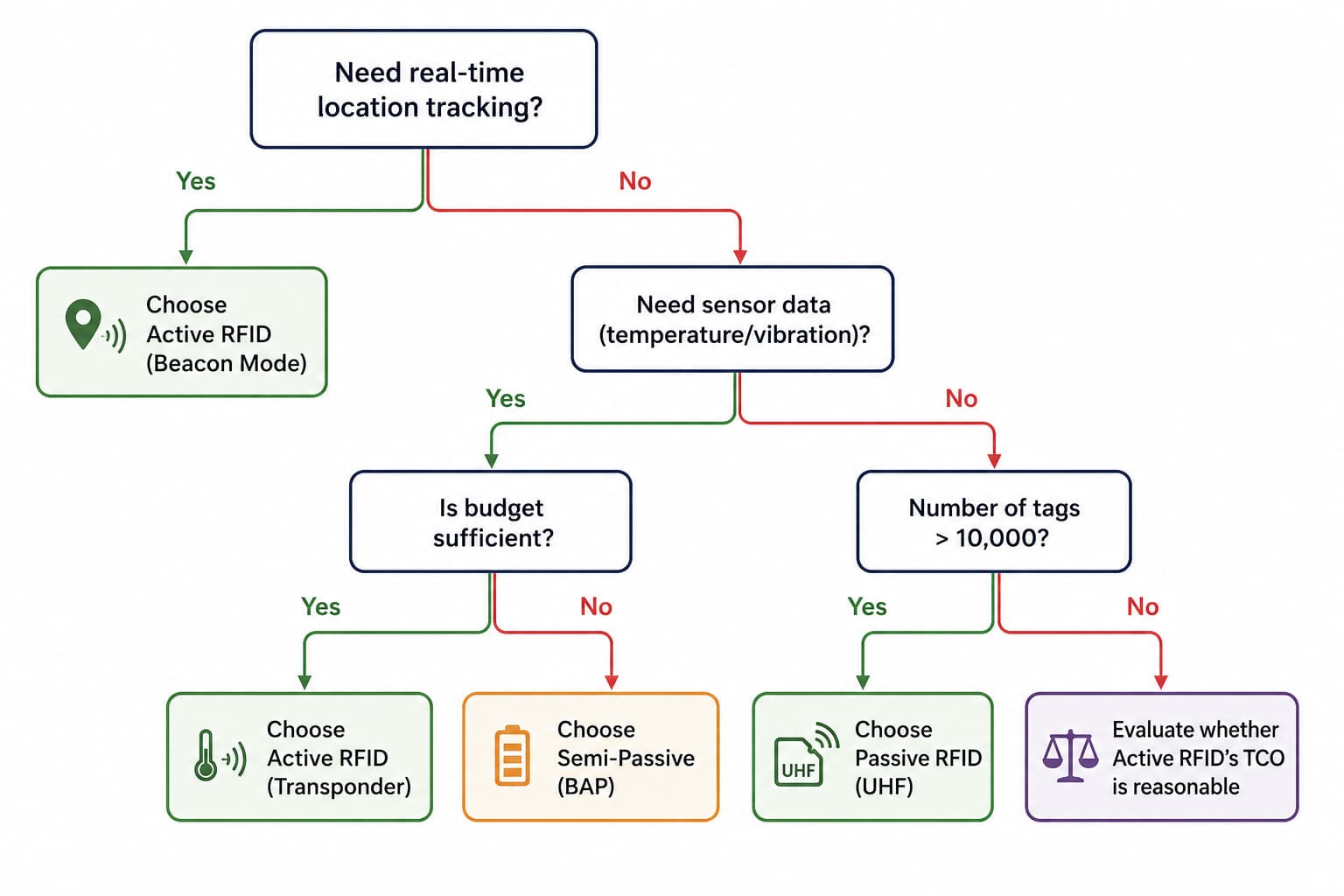
Quick decision
Conclusion
Passive and Active RFID are not in a competitive relationship; rather, they are complementary tools. The majority of enterprises deploy RFID mainly with Passive UHF (covering a large number of low-cost commodity-level tracking), and then add the Active solution in key valuable assets or areas requiring real-time positioning.
The essence of selection lies in finding the optimal balance among reading distance, sensor requirements, deployment scale, and total cost of ownership (TCO).