
High Fiber Optic Loss? Your Cable Labels Might Be the Culprit

Lead Specialist, Telecom Digitalization & Identification at MakeID
As Lead Specialist at MakeID, he drives digital transformation for physical asset identification in FTTx. Optimizing field maintenance and data accuracy, he helps global telecoms reduce MTTR and enable real-time asset-data alignment.
The Culprit Might Be Your Cable LabelIn modern data centers and enterprise networks, troubleshooting high insertion loss or unexpected signal degradation usually follows a familiar checklist. Network engineers clean the connector end-faces with isopropyl alcohol, inspect for dust particles with a fiber scope, check the patch panel splice trays, or run an Optical Time-Domain Reflectometer (OTDR) test.
Yet, even after replacing the patch cords and scrubbing every bulkhead, that persistent, frustrating 0.5 dB drop remains.
If this sounds familiar, it is time to look at a highly overlooked “invisible killer” in your server racks: your cable labels.
While labeling is essential for compliance and structural cable management, using the wrong type of label—or applying it incorrectly—can warp, pinch, or weigh down fragile optical fibers. This creates a hidden bottleneck for high-speed data transmission. Let’s dive deep into the physics of how a simple sticker can degrade a 400G/800G network link, and explore the compliant, high-density labeling solutions designed to fix it.

The Physics of the Flaw: How Labels Steal Your Fiber Signal
To understand how a labeling error impairs performance, we have to look at the structural vulnerability of single-mode and multimode fiber optic patch cords, particularly modern high-density ultra-dense (1.2mm to 2.0mm) cords.
Unlike robust copper Category 6A cables, optical fiber relies on the principle of total internal reflection within a microscopic glass core. When external forces disrupt the geometry of this core, light escapes. Labels cause this through three hidden mechanisms:
Macro-bending and Micro-bending Loss
- Macrobending loss: a gross, visible curve that exceeds the fiber’s minimum bend radius.
- Microbending loss: microscopic deformations caused by uneven lateral pressure on the fiber surface — invisible to the eye, but measurable on an OTDR.
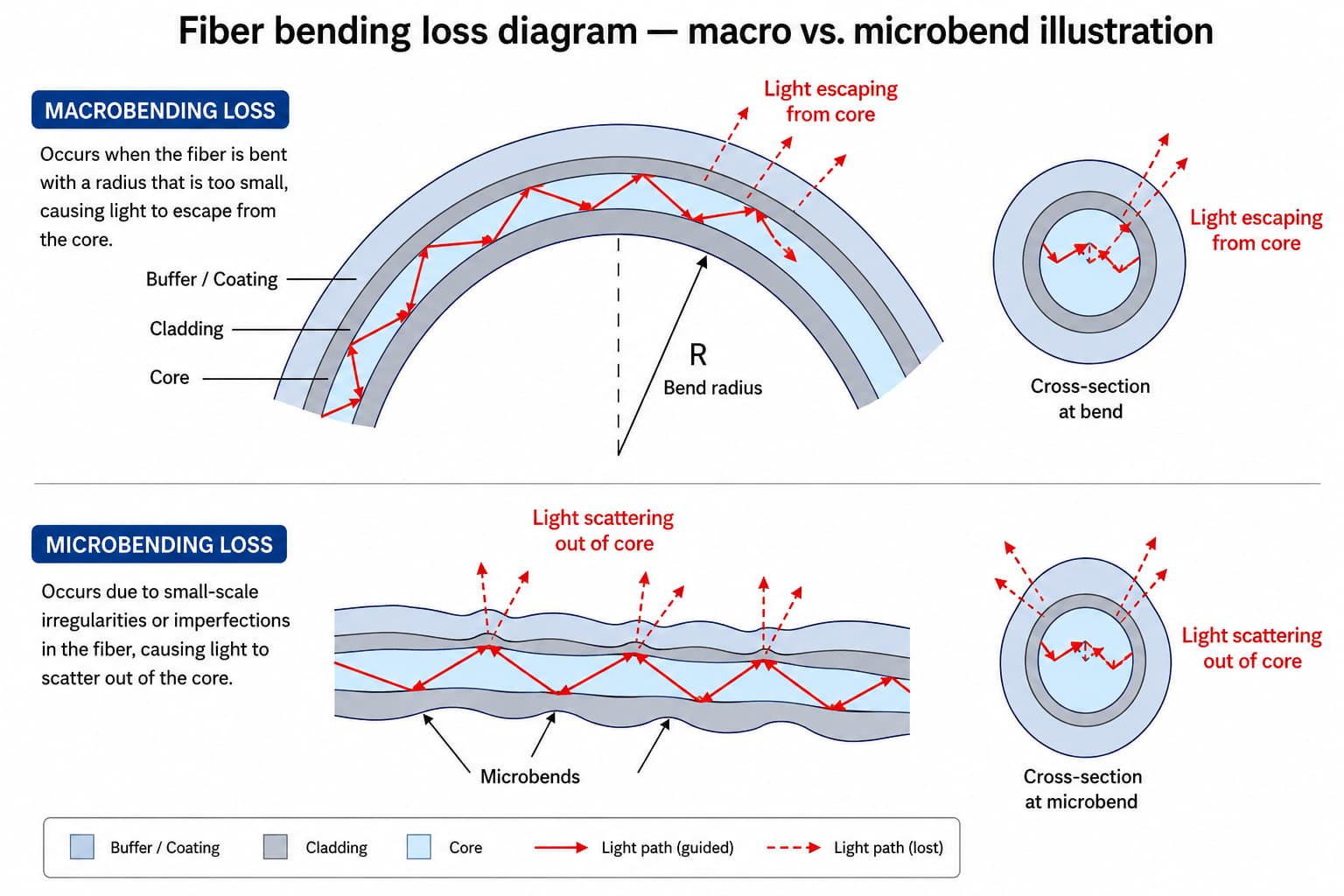
Both anomalies cause light photons to strike the core-cladding boundary at an incorrect angle, refracting straight out of the fiber core and causing immediate signal attenuation.
The “Weight Drop” Effect of Heavy Label Stocks
Modern data centers are increasingly using thin-diameter patch cords—ultra-high-density optical fibers of 2.0mm, 1.6mm, and even 1.2mm. Thinner diameter means higher density, but also lower bending stiffness. When dealing with ultra-thin, high-density fiber patch cables, the weight of the labeling material matters. Standard industrial vinyl or thick plastic tags might seem durable, but their collective material weight (or basis weight) exerts a downward gravitational pull.
When a heavy label is applied near a boot or adapter port, it forces a sharp, V-shaped sag right at the exit point. This localized stress exceeds the cable’s natural bend limits, generating severe macro-bending losses.
The “Tension Noose” of Poorly Wrapped Labels
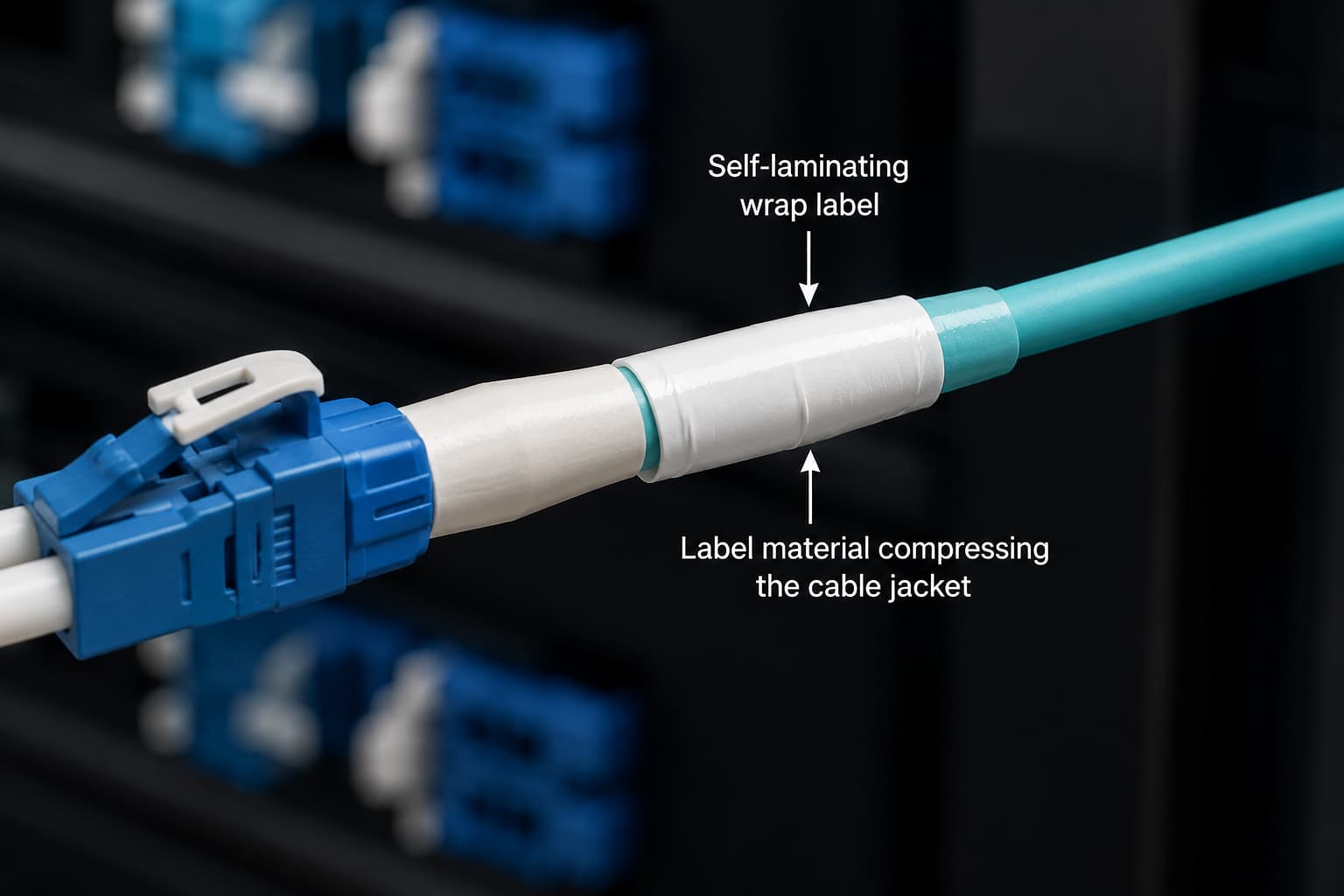
In rushed deployments, field technicians frequently pull self-laminating wrap-around labels as tightly as possible to ensure they won’t slip.
However, many generic adhesive materials expand and contract significantly with the thermal fluctuations of a hot aisle/cold aisle data center enclosure. A tightly wound, rigid PET or paper-based label behaves like a tiny tourniquet. As temperatures shift, it exerts continuous, uneven radial pressure on the soft Low Smoke Zero Halogen (LSZH) jacket, forcing micro-bends directly into the glass core underneath.
High-Density Fixes: Choosing the Right Label Solution
Resolving this issue doesn’t mean compromising on clear asset identification. It means matching your infrastructure with engineered labeling solutions that balance visibility with physical stress relief.
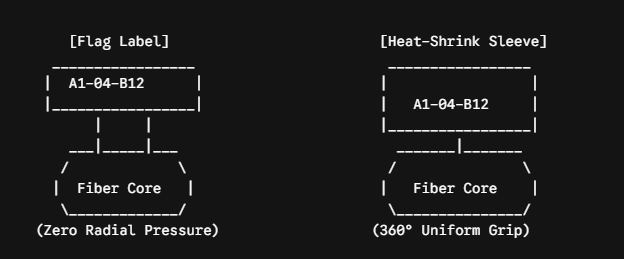
Solution A: Flag Labels (The Balance of Zero Strain)
Flag labels are designed so that the printable area folds back against itself, forming a “flag” that extends away from the cable. Only a small, loose loop touches the actual outer diameter of the patch cord.
- Why they prevent loss: Because the structural adhesive bonds to itself rather than squeezing the cable jacket, flag labels exert zero radial pressure on the optical fiber.
- Best Used For: High-density patch panels, Ultra-Dense $1.2\text{mm}$ patch cords, and crowded Optical Distribution Frames (ODF) where space is tight but cable flexibility must be maintained.
- Selection Tip: Opt for flexible polyolefin or ultra-thin polyester (PET) flag stocks. These materials deliver high tear resistance without adding heavy gravitational dead-weight to the fiber line.
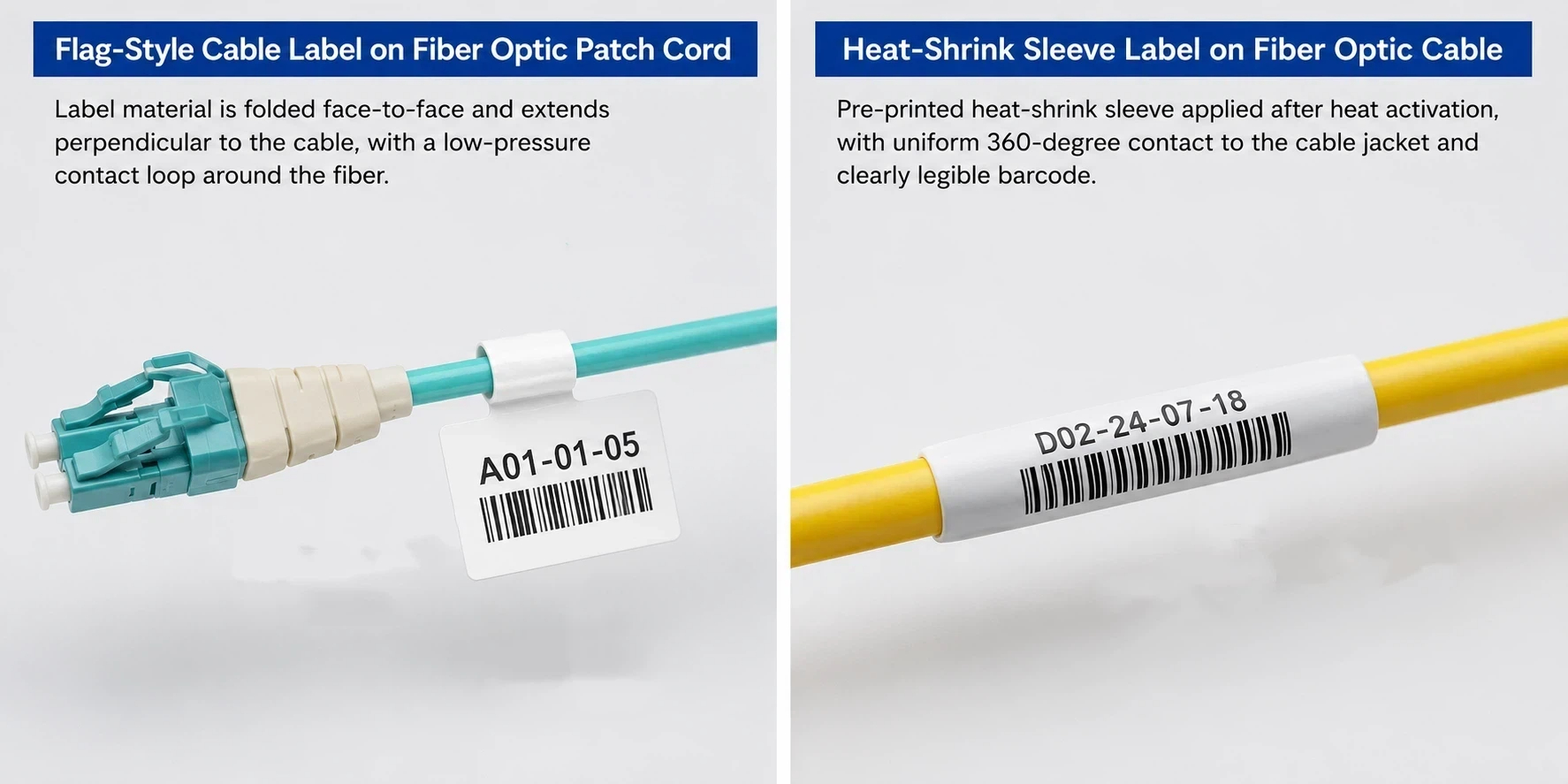
Solution B: Heat-Shrink Sleeves (The Uniform Grid)
Heat-shrinkable sleeves are slid over the fiber wire before termination (or during assembly) and shrunk into place using a controlled industrial heat gun.
- Why they prevent loss: Standard wrap labels apply uneven, overlapping tension points. Conversely, a heat-shrink sleeve compresses at a uniform 2:1 or 3:1 ratio. This distributes compression evenly across a $360^\circ$ axis, eliminating the localized point-pressures that cause micro-bending.
- Added Benefit: Beyond identification, heat-shrink tubing acts as a strain-relief mechanism, reinforcing the fragile junction between the optical jacket and the connector boot.
- Best Used For: Permanent backbone cabling, pigtails, critical trunk lines, and harsh environment fiber deployments.
Building a Fiber Label Standard for Your Data Center
Technical choices only hold if they’re formalized into a written specification that survives staff turnover and vendor changes. Here’s a practical framework.
Specify Weight Limits by Cable Diameter
| Cable Outer Diameter | Maximum Label Mass | Recommended Material |
| 3.0mm standard duplex | ≤ 500 mg | Standard flexible PET |
| 2.0mm slim | ≤ 250 mg | Thin-film polyolefin |
| 1.6mm ultra-slim | ≤ 150 mg | Ultra-thin composite |
| 1.2mm ultra-dense | ≤ 80 mg | Specialized lightweight film |
When in doubt, lighter is always safer.
Verify Adhesive Compatibility with LSZH Jackets
Most modern fiber patch cord jackets are manufactured from LSZH (Low-Smoke Zero-Halogen) compounds. Some adhesives that perform reliably on PVC can cause problems on LSZH over time — plasticizer migration can make the outer sheath brittle, while some acrylic adhesives harden at low temperatures, converting a flexible label contact into a rigid clamp. Request LSZH-specific adhesive compatibility certification from your label supplier before committing to a product.
Mandate Thermal Transfer Printing
Label legibility is a safety issue. A label that can’t be scanned is worse than no label at all. Minimum viable specifications:
- Technology: Thermal transfer (TT) with resin ribbon. Avoid direct thermal — it fades under UV and elevated heat.
- Resolution: 300 dpi minimum; 600 dpi preferred for labels on 1.6mm and 1.2mm cables.
- Barcode format: Code 128 or QR Code for maximum scanner compatibility. Validate first-scan read rates before standardizing a label format.
- Ink resistance: Resin ribbon survives isopropyl alcohol cleaning — critical for labels that remain in place during routine fiber maintenance.
Conclusion: Protect Every Fraction of a Decibel
In the world of high-bandwidth networking, enterprise stability is won or lost in fractions of a decibel. Upgrading to ultra-bend-insensitive fiber or buying expensive low-loss switches yields little benefit if a sub-standard, improperly wrapped $0.10 sticker is pinching your signal off at the patch panel.
By switching to lightweight flag configurations, migrating to uniform heat-shrink options, and selecting industrial thermal transfer media, you can protect your network from phantom insertion losses.
Need to update your data center labeling standards? [Contact MakeID’s Industrial Labeling division today] to learn about our expertise in fiber optic flag labels and high-density MakeID thermal printer kits.